

Have you ever looked at a clock and wondered just how much time you actually have in a single day? We all know there are 24 hours, but when you break it down into tiny, ticking moments, the numbers get much bigger and more exciting! Understanding how many seconds in a day is like uncovering a hidden treasure map of your life. It helps you see that every moment counts, whether you are playing, working, or sleeping. In this guide, we are going to dive deep into the math and history of our 24-hour cycle.
It might seem like a simple question, but the answer tells a story of ancient stars, spinning planets, and super-accurate atomic clocks. By the time we finish, you will not only know the number 86,400 by heart, but you will also understand why time is measured this way. Let’s start our journey through the clock!
The Big Answer: How Many Seconds in a Day?
If you are looking for the quick answer, here it is: there are exactly 86,400 seconds in a day. This number comes from a standard 24-hour period that we use for our calendars and wall clocks. When someone asks how many seconds in a day 86400 is the magic number they are looking for. It is the heartbeat of our modern world, keeping everything from school schedules to rocket launches on track.
But why is it 86,400? This number is not just picked out of thin air. It is the result of multiplying the smaller parts of time together. Think of it like a giant Lego tower; you need many small bricks to make the big structure. In this case, those bricks are minutes and hours.
The Math Behind the Moments
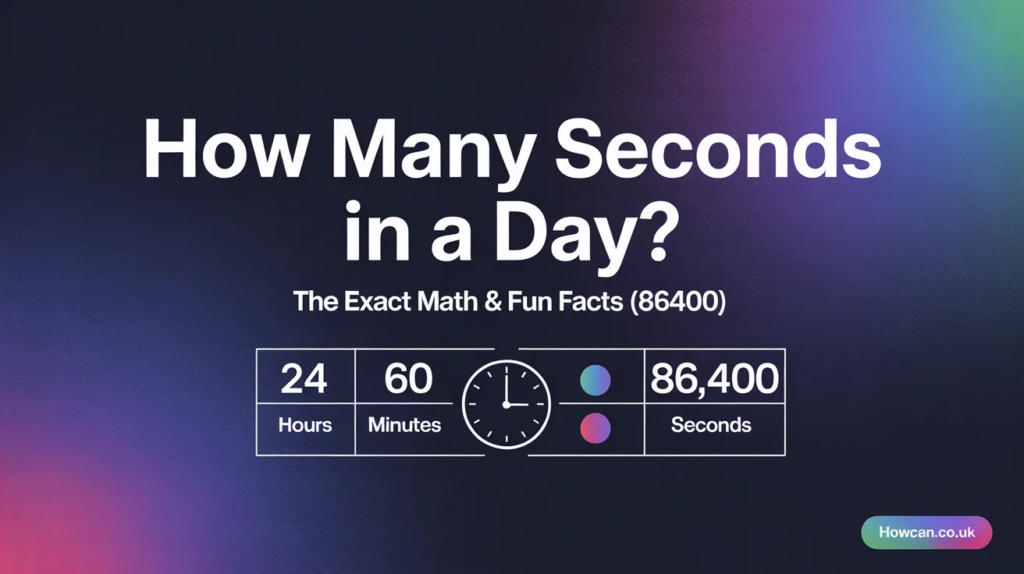
Let’s break down the math so it’s easy to see. To find out how many seconds in a day exactly, we use a simple three-step multiplication. First, we know that one minute has 60 seconds. Next, we know that one hour has 60 minutes. If we multiply 60 by 60, we find that there are 3,600 seconds in one hour.
Finally, since there are 24 hours in a full day, we take those 3,600 seconds and multiply them by 24.
$$3,600 \times 24 = 86,400$$
That is how we get the total! It is a fun bit of math that shows how quickly those tiny seconds add up to a very large number.
Why Do We Use a 24-Hour Day?
You might wonder why we don’t just have 10 hours or 100 hours in a day to make the math easier. We have the ancient Egyptians and Babylonians to thank for our current system. They loved using the number 12 because it was easy to divide into halves, thirds, and quarters. They divided the daylight into 12 parts and the night into 12 parts, giving us the 24-hour day we use now.
When you ask how many seconds in a day? you are actually looking at a system that is thousands of years old. Even though we have fancy smartphones now, we are still using the same logic that people used when they watched shadows on sundials.
Is it Always Exactly 86,400 Seconds?
Here is a little secret: the Earth is actually a bit of a slow-poke! While we say there are how many seconds in a day 86400, the Earth’s rotation is not perfectly steady. Things like the moon’s gravity and even big earthquakes can make the Earth spin a tiny bit slower or faster.
Because of this, scientists sometimes have to add a “leap second” to our clocks. This keeps our human-made time in sync with the planet’s rotation. So, on very rare days, there might actually be 86,401 seconds! However, for almost every day of your life, 86,400 is the perfect answer.
How Many Seconds in a Day Year?
Now that you know the daily count, let’s go even bigger. If you want to know how many seconds in a day year calculation, we have to look at the whole 365-day calendar. To find this, we multiply our daily total by the number of days in a year.
$$86,400 \times 365 = 31,536,000$$
That is over 31 million seconds! And if it is a leap year (which happens every four years), you add another 86,400 seconds for that extra day in February. It’s amazing to think that you have millions of moments to use every single year.
The Role of Atomic Clocks
In the old days, people used the sun to tell time. Today, we use something much cooler: atoms! Scientists use Cesium atoms to measure time because they vibrate at a very steady rate. These atomic clocks are so accurate that they won’t lose a second for millions of years.
When we talk about how many seconds in a day. we are relying on these super-clocks to keep our GPS, internet, and phones working perfectly. Without this precision, your phone’s map wouldn’t know exactly where you are!
Managing Your 86,400 Seconds
Imagine if someone gave you $86,400 every morning, but you had to spend it all by night or you would lose it. You would probably be very careful about how you spent every dollar! Time is the same way. Every morning, you get a fresh batch of 86,400 seconds.
Whether you spend them learning something new, helping a friend, or just relaxing, those seconds are yours. Knowing how many seconds in a day helps us appreciate that time is a gift we get to open every single morning.
Why Accuracy Matters in Science
For most of us, being a few seconds late to dinner isn’t a big deal. But for scientists, every second counts. NASA needs to know the exact second to fire a rocket’s engine so it reaches Mars. Computers need to stay in sync to send emails across the world. This is why knowing how many seconds in a day exactly is so important for modern technology. Even a tiny mistake of one second could cause a satellite to end up in the wrong place.
Conclusion
We have learned that the simple answer to how many seconds in a day is 86,400. We’ve seen the math, explored the history of the 24-hour day, and even looked at how many seconds are in a whole year. Time is a fascinating thing that connects our ancient past to our high-tech future.
The next time you hear a clock tick, remember that you are part of a giant, 86,400-second cycle. How will you use your seconds today? Every tick is a new chance to do something wonderful!
Faqs
1. Is it exactly 86,400 seconds every single day?
Mostly, yes! However, because the Earth’s spin changes slightly, scientists occasionally add a “leap second” to keep our clocks accurate with the planet’s rotation.
2. How many minutes are in a day?
There are 1,440 minutes in a day. You get this by multiplying 24 hours by 60 minutes.
3. Why do we divide hours into 60 minutes?
We use the number 60 because the ancient Babylonians used a “base-60” math system. They found 60 very useful because it can be divided by many numbers like 2, 3, 4, 5, 6, 10, 12, 15, 20, and 30.
4. How many seconds are in a leap year?
In a leap year, there are 366 days. So, you multiply 86,400 by 366, which equals 31,622,400 seconds.
5. What is the smallest unit of time?
While we use seconds every day, scientists use much smaller units like milliseconds (1/1,000 of a second) and even nanoseconds!
6. Who decided a day should have 24 hours?
The ancient Egyptians are often credited with dividing the day and night into 12 parts each, creating the 24-hour cycle we still use today.